Best Piononos de Santa Fe Near Me? How to Find the Real Granada Pastry—and Bake It at Home

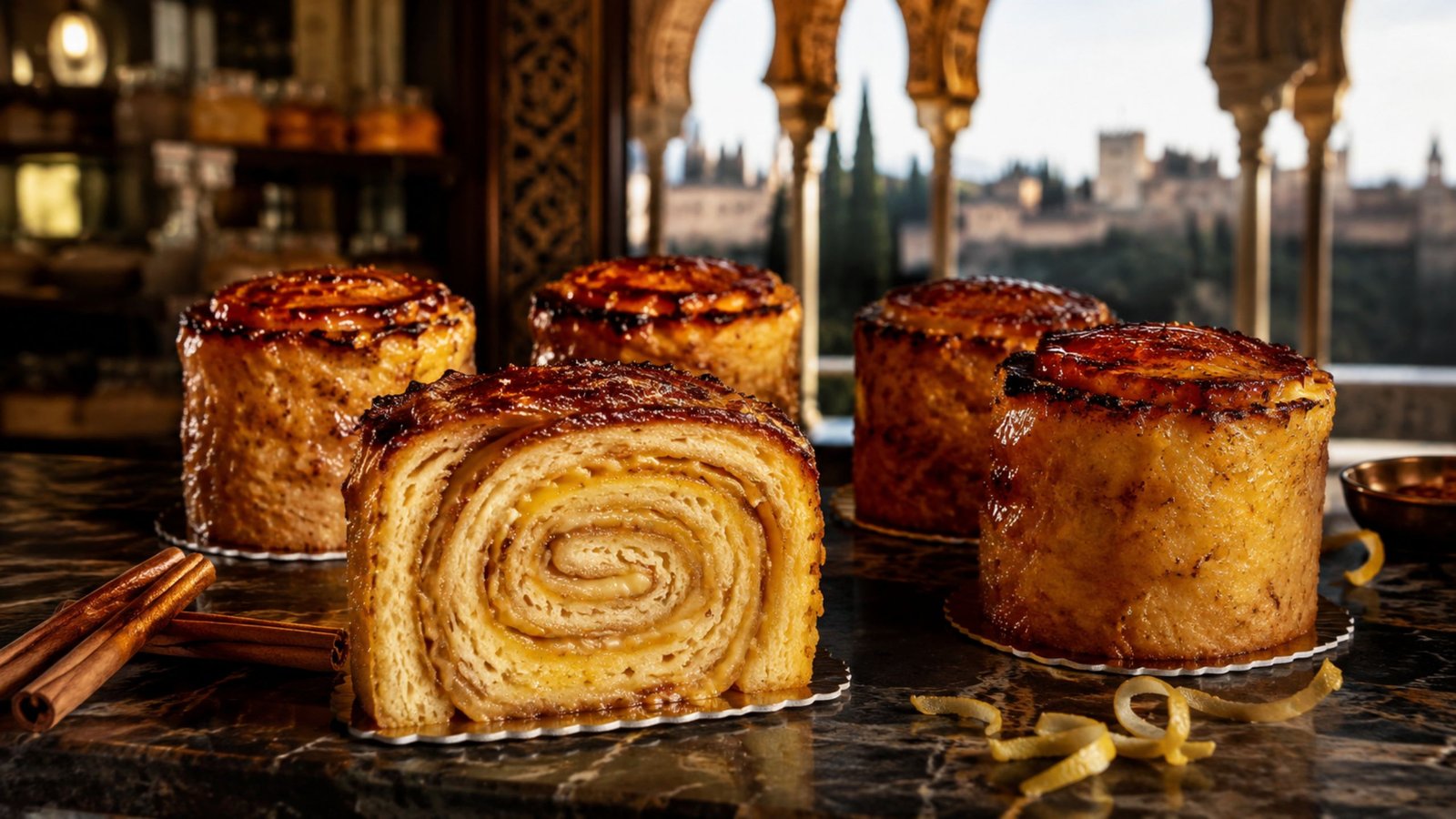
The best pionono is not simply a miniature cake roll; it is a syrup-soaked, cinnamon-scented Granada pastry crowned with custard and finished under an open flame.
Searching for the best Piononos de Santa Fe near me can produce confusing results. Some bakeries use “pionono” for large Latin American sponge rolls, cream-filled cakes or savoury roulades. The authentic Santa Fe version is different: compact, upright, glossy with syrup and small enough to finish in one or two bites.
Its appeal depends on precision. The sponge must be thin enough to roll without cracking, porous enough to absorb syrup and firm enough to remain upright. The custard should taste of egg, milk, cinnamon and citrus—not artificial vanilla frosting. The caramelised crown must crack delicately before giving way to cool cream.
This home formulation reproduces those defining characteristics without pretending to reveal the proprietary formula used by Granada’s historic pastry houses. It combines a flexible sheet sponge, cinnamon-lemon syrup, cooked custard and a freshly torched sugar crust.
The secret to perfect Piononos de Santa Fe is a thin, flexible sponge that absorbs cinnamon-lemon syrup without collapsing, followed by a restrained layer of custard and a freshly torched crown. That balance creates the defining contrast: moist spiral, clean structure, warm spice and brittle caramel.
Before You Trust a “Piononos Near Me” Search Result
A genuine Pionono de Santa Fe should be an upright cylindrical pastry, not a horizontal slice cut from a large decorated Swiss roll. The exterior should look moist and lightly glossy, while the spiral remains visible when the pastry is cut open.
Use these criteria when comparing bakeries, Spanish cafés and Andalusian restaurants:
- Search for “Pionono de Santa Fe,” “pionono granadino,” “pastelería española” or “Andalusian bakery”, not only “pionono.”
- Look for a compact cylinder approximately 3–5 centimetres wide.
- Confirm that the sponge is soaked with syrup rather than covered with buttercream.
- Expect a thin cinnamon-scented cream layer inside the spiral.
- Check for a piped custard crown with visibly caramelised sugar.
- Ask whether the pastries are made in-house, delivered frozen or finished to order.
- Prefer bakeries with high pastry turnover and refrigerated display cases.
- Avoid versions dominated by thick frosting, whipped topping or a dry cake crumb.
Freshness matters. A well-made pionono should feel tender and saturated but should not release a pool of syrup into its paper case. The custard should remain cool, and the caramelised surface should retain at least a slight brittle texture.
The Pionono in One Glance
- Recipe yield: 12 individual piononos
- Active preparation: 45 minutes
- Cooking and baking: 25 minutes
- Cooling and chilling: Approximately 60 minutes
- Total time: 2 hours 10 minutes
- Oven temperature: 200°C conventional or 180°C fan
- Custard target temperature: 82–85°C
- Serving temperature: Approximately 8–12°C
- Estimated energy: About 220 calories per pionono
- Best texture window: Within 24 hours of assembly
Calorie values are estimates because the final figure depends on how much syrup the sponge absorbs and how much custard is piped onto each portion.
Santa Fe’s Small Pastry with a Precise Identity
Piononos are closely associated with Santa Fe, a town near Granada in Andalusia. Granada’s official tourism authority describes them as one of the province’s characteristic sweets and considers them reason enough to visit Santa Fe.
The historical account published by Casa Isla dates the modern pastry to 1897, when pastry chef Ceferino Isla González opened his bakery in Santa Fe. According to that account, the name refers to Pope Pius IX—Pío Nono in Italian—and the pastry’s cylindrical body and cream crown were designed to recall papal dress.
Modern bakery production still follows the same basic architecture: thin sponge, aromatic syrup, a light cream layer, cinnamon, a tight roll and a toasted cream crown. Reporting from a Granada bakery describes sponge strips receiving syrup, cream and cinnamon before being rolled, stood upright and finished with sugared cream under a flame.
For additional regional context, see the official Granada tourism guide to Santa Fe.
The Formulation Grid: Everything Needed for 12 Piononos
| Component | Ingredient | Exact amount | Substitution or sourcing note |
|---|---|---|---|
| Flexible sponge | Large eggs | 4, about 200 g without shells | Use room-temperature eggs for greater volume |
| Flexible sponge | Caster sugar | 100 g | Superfine sugar dissolves fastest |
| Flexible sponge | Cake flour | 80 g | Use 70 g plain flour plus 10 g additional cornstarch if unavailable |
| Flexible sponge | Cornstarch | 20 g | Reduces gluten strength and keeps the sheet flexible |
| Flexible sponge | Fine sea salt | ¼ teaspoon | Do not omit; it controls perceived sweetness |
| Flexible sponge | Finely grated lemon zest | ½ teaspoon | Grate only the yellow outer peel |
| Aromatic syrup | Water | 150 ml | Filtered water is preferable where tap water is strongly chlorinated |
| Aromatic syrup | Granulated sugar | 150 g | White sugar preserves the traditional pale colour |
| Aromatic syrup | Cinnamon stick | 1 | Use Ceylon cinnamon for a softer aroma or cassia for greater intensity |
| Aromatic syrup | Wide strips of lemon peel | 3 | Avoid the bitter white pith |
| Aromatic syrup | Whole aniseed, lightly crushed | ½ teaspoon | Optional but useful for a subtle Andalusian-style aromatic note |
| Cooked cream | Whole milk | 350 ml | Do not replace with low-fat milk unless necessary |
| Cooked cream | Egg yolks | 4 | Large yolks, approximately 70–75 g total |
| Cooked cream | Whole egg | 1 | Helps the cream set cleanly |
| Cooked cream | Caster sugar | 100 g | Divide only if tempering by hand |
| Cooked cream | Cornstarch | 35 g | Provides a pipeable consistency after chilling |
| Cooked cream | Cinnamon stick | 1 | Remove before tempering |
| Cooked cream | Wide strips of lemon peel | 2 | Orange peel may be used for a different citrus profile |
| Cooked cream | Fine sea salt | ⅛ teaspoon | Sharpens the milk, egg and caramel notes |
| Cooked cream | Unsalted butter | 20 g | Stir in after cooking for a smoother finish |
| Assembly | Ground cinnamon | 1 teaspoon | Use a fine powder so the spiral rolls evenly |
| Assembly | Superfine sugar | 25 g | Required for the caramelised crowns |
Equipment That Prevents Structural Failure
Use a 30 × 40-centimetre rimmed baking tray, parchment paper, fine-mesh sieve, digital thermometer, offset spatula, pastry brush, piping bag and kitchen blowtorch.
A stand mixer or electric hand mixer is strongly recommended. Whole eggs require sustained aeration to produce a sponge that is thin yet resilient.
Why the Sponge Drinks Syrup Instead of Drowning
The sponge contains no added butter or oil. That is intentional. Fat coats flour particles and can reduce the cake’s ability to absorb the aromatic syrup evenly.
Whipped eggs provide the primary structure. During mixing, proteins surround thousands of small air bubbles. Heat expands those bubbles in the oven while the egg proteins and starches set around them. A short, hot bake preserves elasticity; prolonged baking removes too much moisture and creates a brittle sheet that cracks during rolling.
Cornstarch performs two functions. First, it dilutes the gluten-forming proteins in the flour. Second, it creates a finer crumb with small, evenly distributed pores. Those pores draw syrup inward through capillary action rather than allowing it to collect only on the surface.
The syrup must also have the correct concentration. A very thin syrup makes the cake watery and fragile. An overcooked syrup becomes sticky, heavy and difficult to distribute. A brief three-minute simmer produces enough concentration to moisten the sponge without turning the spiral into paste.
Custard introduces another structural risk. Too much filling creates hydraulic pressure as the sponge is rolled, forcing cream out of the seam. A layer approximately 2–3 millimetres thick is sufficient. The remaining cream belongs on top, where it forms the pionono’s defining crown.
The Two-Hour Execution Timeline
1. Cook the Cinnamon-Lemon Cream — 15 Minutes
Place 350 ml whole milk, one cinnamon stick and two strips of lemon peel in a saucepan. Heat over medium-low heat until steaming and registering approximately 75–80°C. Do not allow it to boil aggressively.
Remove the saucepan from the heat, cover and infuse for five minutes.
In a heatproof bowl, whisk four egg yolks, one whole egg, 100 g caster sugar, 35 g cornstarch and ⅛ teaspoon salt until completely smooth.
Remove the cinnamon and lemon peel from the milk. Slowly pour approximately one-third of the hot milk into the egg mixture while whisking continuously. Add the remaining milk, then return everything to the saucepan.
Cook over medium heat, whisking constantly, until the cream reaches 82–85°C, produces a full bubble and becomes thick enough to hold whisk trails. Continue whisking for 60 seconds to cook the starch thoroughly.
USDA guidance states that egg mixtures should reach at least 71.1°C or 160°F. This custard exceeds that minimum and is cooked until bubbling for both safety and proper starch activation. See the USDA guidance for safely cooking egg dishes.
Remove the pan from the heat and whisk in 20 g unsalted butter. Spread the cream in a shallow container, cover its surface directly with food-safe wrap and refrigerate for at least 45 minutes.
2. Build the Aromatic Syrup — 20 Minutes Including Infusion
Combine 150 ml water, 150 g granulated sugar, one cinnamon stick, three strips of lemon peel and ½ teaspoon lightly crushed aniseed in a small saucepan.
Bring to a gentle boil, then simmer for exactly three minutes. Remove from the heat, cover and infuse for 15 minutes.
Strain the syrup and allow it to cool to approximately 35–40°C. Warm syrup penetrates the sponge more evenly than refrigerated syrup, but very hot syrup can weaken the cake.
3. Aerate the Sponge Base — 10 Minutes
Preheat the oven to 200°C conventional or 180°C fan. Line a 30 × 40-centimetre tray with parchment paper.
Sift together 80 g cake flour, 20 g cornstarch and ¼ teaspoon fine sea salt.
Place four room-temperature eggs, 100 g caster sugar and ½ teaspoon lemon zest in the mixer bowl. Whip on high speed for 8–10 minutes.
The mixture is ready when it has approximately tripled in volume, looks pale and falls from the whisk in a thick ribbon that remains visible on the surface for five seconds.
4. Fold Without Deflating — 3 Minutes
Add the sifted dry mixture in three additions.
Fold with a broad spatula, cutting down through the centre and lifting the batter from the bottom. Rotate the bowl after each fold.
Stop as soon as no dry flour remains. Excessive folding ruptures the air cells and produces a dense, rubbery sheet.
5. Bake the Sheet Before It Becomes Brittle — 8 to 10 Minutes
Spread the batter evenly across the lined tray. Work into the corners without repeatedly pressing out the air.
Bake for 8–10 minutes. The surface should be pale golden, dry to the touch and spring back immediately when pressed gently.
Do not wait for deep browning. A dark sheet is usually too dry to roll cleanly.
6. Release and Rest the Sponge — 5 Minutes
Place a fresh sheet of parchment on the work surface. Turn the warm sponge onto it and carefully peel away the baking parchment.
Cover loosely with a clean tea towel and rest for five minutes. The trapped moisture keeps the surface flexible.
Trim only visibly dry or uneven edges.
7. Apply Syrup, Cream and Cinnamon — 5 Minutes
Brush 120–140 g of the warm syrup evenly over the entire sponge. Pause for 30 seconds, then check the surface.
It should look glossy and feel moist but should not release liquid when pressed. Reserve unused syrup rather than forcing all of it into the cake.
Whisk the chilled cream briefly until smooth. Spread approximately 220 g across the sponge in a 2–3-millimetre layer.
Dust evenly with one teaspoon ground cinnamon.
8. Form the Spiral — 3 Minutes Plus 25 Minutes Chilling
Starting from one long edge, roll the sponge into a firm log. Use the parchment to guide the cake forward without squeezing out the cream.
Position the log seam-side down. Wrap it in parchment and refrigerate for 25 minutes.
Chilling stabilises the filling and produces cleaner slices.
9. Cut and Stand the Piononos Upright — 5 Minutes
Trim both ends of the log.
Measure and cut the remaining log into 12 equal pieces, each approximately 3–3.5 centimetres wide. Clean the knife between cuts.
Turn every piece upright so the spiral is vertical. Place each one in a small paper pastry case if available.
10. Pipe, Sugar and Torch the Crowns — 10 Minutes
Transfer the remaining chilled cream to a piping bag fitted with a plain or open-star nozzle.
Pipe a compact crown onto each upright spiral. Avoid oversized swirls; the cream should complement the syrup-soaked sponge rather than outweigh it.
Sprinkle each crown evenly with superfine sugar.
Hold a kitchen blowtorch 8–10 centimetres from the surface. Move the flame continuously for 10–20 seconds until the sugar melts, bubbles and develops an amber crust.
Refrigerate for 20 minutes before serving.
What a Correctly Made Pionono Looks and Feels Like
A successful Pionono de Santa Fe should pass five tests:
- The upright test: The cylinder remains vertical without leaning or spreading.
- The spiral test: The interior shows distinct sponge and cream layers.
- The syrup test: The cake is saturated throughout but does not drip.
- The spoon test: The custard cuts cleanly rather than flowing.
- The torch test: The crown carries small amber and dark-gold patches without tasting burnt.
The first bite should deliver cool custard and a thin caramel crack. The centre should taste moist, gently spiced and distinctly egg-rich, with lemon and cinnamon preventing the sugar from becoming monotonous.
Questions Pionono Buyers and Bakers Ask
What is a Pionono de Santa Fe?
A Pionono de Santa Fe is a small Spanish pastry from Santa Fe in Granada province, made from thin rolled sponge soaked in aromatic syrup, layered with cream and cinnamon, stood upright and crowned with caramelised custard. It is distinct from the larger filled sponge rolls called piononos in several Latin American cuisines.
How do I find the best Piononos de Santa Fe near me?
The best local search method is to combine the dish name with bakery type and location. Search for “Pionono de Santa Fe,” “Spanish bakery,” “Granada pastry” and “Andalusian café” with your city. Prioritise businesses showing an upright syrup-soaked spiral with a torched custard crown and ask whether the pastries are made in-house.
Is a Pionono de Santa Fe the same as a Swiss roll?
A Pionono de Santa Fe is not simply a miniature Swiss roll. Both use rolled sponge, but the Santa Fe pastry is heavily moistened with spiced syrup, sliced into individual cylinders, turned upright and topped with caramelised cream. A conventional Swiss roll is generally served horizontally and relies more heavily on jam, cream or frosting.
How long do homemade piononos stay fresh?
Homemade piononos remain at their best for 24 hours and are generally suitable for refrigerated storage for up to three days. Keep them in a covered container at 4°C or below. The sponge will continue absorbing moisture, while the caramelised sugar crust gradually softens, so texture declines before the pastry becomes unusable.
Can Piononos de Santa Fe be frozen?
Piononos can be frozen most successfully before the final cream crown is torched. Freeze the filled and sliced sponge cylinders on a tray, then transfer them to an airtight container for up to one month. Thaw overnight in the refrigerator, add fresh custard crowns, sprinkle with sugar and torch immediately before serving.
Can I caramelise the tops without a blowtorch?
A hot grill or broiler is a workable alternative, but it provides less control. Place fully chilled piononos on a cold metal tray, sprinkle the crowns with sugar and position them briefly beneath a fully preheated grill. Watch continuously and remove them as soon as the sugar turns amber, usually within 30–90 seconds.
The Last Bite Should Still Hold Its Shape
The best Piononos de Santa Fe are built around restraint. More cream does not make them more authentic. More syrup does not make them more succulent. More torching does not produce better caramel.
The pastry succeeds when each component stops at the correct point: the sponge before it dries, the syrup before it thickens, the custard after it sets and the sugar as soon as it turns amber.
That is also the standard to use when searching for the best piononos near you. Look beyond decorative presentation and inspect the engineering of the pastry itself. A proper pionono should be moist enough to feel indulgent, structured enough to stand upright and small enough to leave a precise final impression rather than simple sugar fatigue.