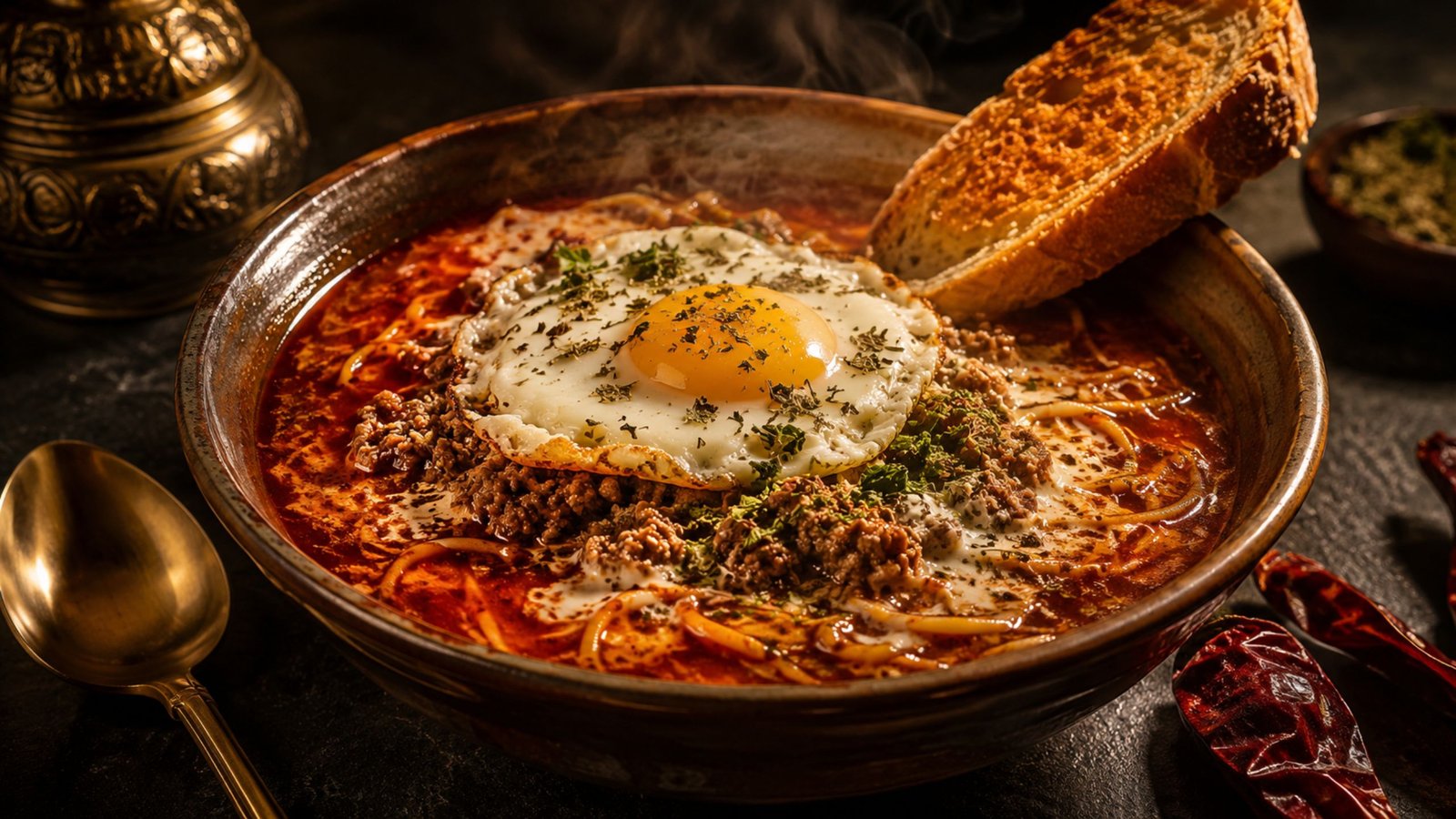
Best Sopa Criolla Near Me? This Lima-Style Beef Noodle Soup Delivers the Restaurant Experience at Home

Deeply savoury beef broth, smoky ají panca, delicate noodles, creamy milk and a fried egg turn one fast-cooking soup into serious Peruvian comfort food.
Searching for the best sopa criolla near me usually begins with a craving that ordinary beef noodle soup cannot satisfy. Sopa criolla has more depth: brick-red ají panca, browned beef, tomato, oregano, angel hair pasta and evaporated milk, finished with an egg and crisp bread.
The problem is availability. Even Peruvian restaurants may serve sopa criolla only as a rotating lunch special, while some menus call a closely related preparation sopa a la minuta. The two names often overlap, and distinctions involving tomato paste, milk, egg or noodles can vary by restaurant and household.
This recipe removes that uncertainty. It produces a Lima-style bowl in approximately 35 minutes, using a properly developed onion-and-ají base rather than relying on bouillon, excessive cream or uncontrolled chilli heat. Sopa criolla is widely recognised as a traditional Peruvian dish, including in official Peruvian cultural and gastronomic presentations.
The secret to perfect sopa criolla is definitively the staged cooking of ají panca, tomato paste and beef before the stock is added. Frying this concentrated base develops smoky sweetness and savoury depth, while adding evaporated milk below a full boil preserves a smooth, lightly creamy broth.
The Bowl at a Glance
- Preparation time: 12 minutes
- Cooking time: 23 minutes
- Total time: 35 minutes
- Yield: 6 substantial bowls
- Cuisine: Peruvian, particularly associated with Lima’s criollo cooking
- Primary flavour: Savoury beef, mild smoky chilli, tomato and oregano
- Heat level: Mild to medium
- Estimated calories: Approximately 410 per serving without toast
- Best serving temperature: 165–175°F or 74–79°C
- Best pasta: Broken angel hair or very fine vermicelli
How to Recognise a Sopa Criolla Worth Ordering
When evaluating local restaurants, search for both “sopa criolla” and “sopa a la minuta” alongside the name of your city. Call before travelling because the soup may appear only on a lunch menu or cold-weather special.
A convincing restaurant bowl should contain most of these elements:
- Beef that tastes browned rather than merely boiled
- A red-brown broth seasoned with ají panca
- Fine noodles rather than thick spaghetti
- Tomato used for depth, not enough to make the soup taste Italian
- A restrained quantity of evaporated milk
- Dried oregano crushed immediately before serving
- A cooked egg, either fried, poached or stirred into the broth
- Toasted or fried bread served on top or alongside
Ají panca is especially important. It contributes a dark red colour and a rounded, mildly smoky pepper character rather than aggressive heat. Peru’s official gastronomy portal regularly features ají panca in traditional preparations, demonstrating its central role in Peruvian seasoning. See the official Peru gastronomy guide to ají panca in traditional cooking.
The Lima-Style Formulation Grid
| Component | Exact quantity | Practical substitution | Selection and sourcing notes |
|---|---|---|---|
| Neutral cooking oil | 2 tablespoons, divided | Light olive oil | Reserve half for cooking the eggs |
| Lean ground beef | 1 pound / 450 grams | Finely diced sirloin or chuck | Use 85–90% lean beef; very lean meat can taste dry |
| Yellow or red onion | 1 medium, about 1½ cups finely diced | White onion | Cut into ¼-inch pieces so it dissolves into the broth |
| Garlic | 4 cloves, finely minced | 1½ teaspoons garlic paste | Fresh garlic gives a cleaner finish |
| Ají panca paste | 2 tablespoons / 30 grams | 1 tablespoon mild red chilli paste plus 1 teaspoon smoked paprika | Choose pure paste without excessive vinegar or preservatives |
| Tomato paste | 2 tablespoons / 32 grams | ⅓ cup finely grated fresh tomato, reduced longer | Double-concentrated paste gives the deepest flavour |
| Ground cumin | ½ teaspoon | None preferred | Keep the quantity restrained |
| Dried oregano | 1½ teaspoons, divided | Mexican oregano | Rub it between your palms before adding |
| Fine black pepper | ½ teaspoon | White pepper | Freshly ground pepper is preferable |
| Beef stock | 6 cups / 1.4 litres | Low-sodium chicken stock | A low-sodium stock allows accurate final seasoning |
| Fine angel hair pasta | 4 ounces / 115 grams | Fine vermicelli or fideo | Break into 2-inch or 5-centimetre lengths |
| Evaporated milk | ¾ cup / 180 millilitres | Whole milk mixed with 2 tablespoons heavy cream | Warm it slightly before adding |
| Large eggs | 6 | Pasteurised eggs | Use one egg per bowl |
| Fine salt | 1 teaspoon initially, plus more as required | Kosher salt, adjusted by weight | Stock salinity varies considerably |
| Flat-leaf parsley | 2 tablespoons chopped | Coriander leaves | Parsley provides the more neutral finish |
| Small baguette slices | 6, toasted, optional | Croutons or plain white toast | Keep the bread crisp until serving |
| Lime wedges | 6, optional | None | Add only at the table; acid can destabilise the milk |
The 35-Minute Execution Timeline
Minute 0–4: Build a Proper Browning Surface
Place a heavy 4- to 5-quart saucepan or Dutch oven over medium-high heat for 90 seconds. Add 1 tablespoon oil.
Add the ground beef in a broad, even layer. Leave it undisturbed for 2 minutes before breaking it into small pieces. Continue cooking for another 2 minutes, until the meat has browned patches and no raw exterior remains.
Ground beef should reach 160°F or 71.1°C for food safety. The USDA safe minimum internal-temperature chart specifies this temperature for ground meats.
Transfer the browned beef to a clean bowl, leaving the rendered fat and browned residue in the pot.
Minute 4–10: Concentrate the Criollo Seasoning Base
Reduce the heat to medium. Add the diced onion with a small pinch of salt.
Cook for 4 minutes, stirring regularly, until the onion is translucent and beginning to turn golden at its edges. Add the garlic and cook for 30 seconds.
Add the ají panca paste, tomato paste, cumin, 1 teaspoon oregano and black pepper. Fry the mixture for 90 seconds, stirring continuously.
The paste is ready when it darkens from bright red to deep brick-red, becomes glossy and begins sticking lightly to the bottom. It should smell sweet, smoky and roasted—not raw or sharply acidic.
Minute 10–13: Recover Every Layer of Flavour
Return the beef to the pot. Pour in approximately 1 cup of the stock and scrape the bottom firmly with a wooden spoon.
Add the remaining 5 cups of stock and the initial 1 teaspoon salt. Increase the heat to high and bring the soup just to a boil.
Minute 13–21: Create the Beef-and-Ají Broth
Once boiling, immediately reduce the heat to maintain a steady simmer at approximately 190–200°F or 88–93°C.
Simmer uncovered for 8 minutes. A small amount of fat may rise to the surface; remove only an excessive layer. Some fat is necessary because it carries the pepper and oregano aromas.
Taste the broth. At this stage it should be slightly stronger and saltier than the desired finished soup because the milk will soften its intensity.
Minute 21–25: Cook the Noodles in the Broth
Break the angel hair into approximately 2-inch lengths and scatter it gradually into the simmering soup while stirring.
Cook for 3 to 4 minutes, or according to the package’s lower cooking-time recommendation. Stir twice to prevent the strands from forming a dense bundle.
Stop cooking while the noodles retain a faint central firmness. They will continue absorbing hot broth after the pot leaves the stove.
Minute 25–27: Add Milk Without Flattening the Broth
Reduce the heat to low. Slowly pour in the warmed evaporated milk while stirring.
Heat for 1 to 2 minutes, keeping the liquid below a boil. The ideal temperature is approximately 180–190°F or 82–88°C.
Taste and adjust the salt. The finished broth should be savoury and lightly creamy, but it should not resemble a thick chowder.
Turn off the heat and cover the pot loosely.
Minute 27–32: Cook the Egg Garnish
Heat the remaining 1 tablespoon oil in a large non-stick frying pan over medium heat.
Cook the eggs in batches until the whites are fully opaque. Leave the yolks soft for a restaurant-style finish or cook them completely for children, pregnant diners, older adults or anyone who should avoid undercooked eggs.
Season each egg with a small pinch of salt and black pepper.
Minute 32–35: Assemble Without Losing Texture
Divide the noodles, beef and broth among six warm bowls.
Place one fried egg over each serving. Sprinkle with the reserved ½ teaspoon crushed oregano and chopped parsley. Add one crisp baguette slice to the edge of each bowl immediately before serving.
Offer lime separately rather than squeezing it into the entire pot.
Why the Broth Tastes Rich Without Heavy Cream
Sopa criolla depends on flavour concentration, not dairy volume.
The first mechanism is browning. When beef contacts a sufficiently hot pot, amino acids and reducing sugars undergo Maillard reactions, producing roasted, savoury compounds. If the meat is immediately stirred or crowded into a cold pan, it releases water and steams instead.
The second mechanism is fat-soluble extraction. Ají panca contains aromatic and colour compounds that disperse more effectively when fried briefly in oil. Cooking the paste with onion, garlic and tomato also removes its raw edge. Adding it directly to stock would produce a thinner, less integrated taste.
The third mechanism is controlled starch release. Fine pasta cooks directly in the stock, releasing a modest amount of starch. This gives the broth enough body to hold the milk and rendered beef fat in suspension without flour or cornstarch.
Evaporated milk is added last because prolonged boiling can dull its flavour and increase the possibility of graininess, particularly in a tomato-based broth. Low heat preserves a clean dairy finish while still allowing the milk to soften the chilli, cumin and beef.
“The most damaging mistake is treating sopa criolla like a cream soup. Milk is a finishing ingredient, not the foundation. The broth must already taste complete before the dairy enters the pot.” — AB Rehman
Calibrating the Recipe to Your Preferred Restaurant Style
For a darker, smokier bowl
Increase the ají panca paste from 2 tablespoons to 2½ tablespoons. Fry it for the full 90 seconds, but do not let the garlic scorch.
For a brighter tomato profile
Add ½ cup of peeled, finely diced tomato after the onion. Cook it for 5 to 6 minutes before adding the concentrated tomato paste.
For sliced beef instead of ground beef
Use 1 pound of sirloin or tender chuck sliced across the grain into narrow strips. Sear it quickly, remove it from the pan and return it during the final 3 minutes of simmering.
For egg cooked directly in the soup
Crack the eggs individually into small cups. After adding the milk, keep the soup at a very gentle simmer and slide in the eggs. Cover and cook for 3 to 5 minutes, until the whites are set.
For a lighter version
Use 93% lean beef, reduce the evaporated milk to ½ cup and omit the fried bread. Do not remove the ají panca or oregano; those ingredients carry the dish’s identity.
Questions Diners Ask Before Making Sopa Criolla
What is sopa criolla?
Sopa criolla is a Peruvian beef-and-noodle soup prepared with an onion and garlic seasoning base, ají panca, tomato, fine pasta, oregano and milk. Many versions are finished with an egg and fried or toasted bread. It is particularly associated with fast, warming criollo meals served in Lima.
Is sopa criolla the same as sopa a la minuta?
Sopa criolla and sopa a la minuta are closely related Peruvian soups, and the names are sometimes used interchangeably. Depending on the cook, sopa criolla may contain a more pronounced tomato base, evaporated milk, egg or additional garnishes. Restaurant menus are not completely consistent, so searching both names produces better local results.
What can replace ají panca paste?
The best ají panca substitute is a mild red chilli paste combined with smoked paprika. For 2 tablespoons ají panca, use 1 tablespoon mild red chilli paste, 2 teaspoons tomato paste and 1 teaspoon smoked paprika. The replacement approximates the colour and smoke, although it cannot fully reproduce ají panca’s fruity depth.
Can sopa criolla be prepared without evaporated milk?
Sopa criolla can be made without evaporated milk, but its texture will be less rounded. Substitute ¾ cup whole milk and reduce the stock by ¼ cup. Unsweetened oat milk can work for a dairy-free bowl, although it introduces a slight cereal flavour. Coconut milk is not recommended because it changes the dish’s Peruvian criollo profile.
How long does sopa criolla keep in the refrigerator?
Refrigerated sopa criolla keeps for 3 to 4 days when cooled promptly and stored at 40°F or 4°C or below. Transfer it to shallow containers within 2 hours of cooking. USDA guidance also recommends using most cooked leftovers within 3 to 4 days.
For better noodle texture, store the cooked pasta separately when preparing the soup specifically for meal prep.
Can sopa criolla be frozen?
The beef-and-ají broth can be frozen for up to 3 months, but the completed soup is not ideal for freezing. Pasta becomes soft, dairy can separate and cooked eggs lose their texture. Freeze the broth before adding noodles, milk or eggs, then complete those elements after reheating.
What is the best way to reheat sopa criolla?
The best reheating method is gentle stovetop heating. Place the soup over medium-low heat and stir frequently until it reaches at least 165°F or 74°C. Add a splash of stock if the noodles have absorbed too much liquid. Avoid a hard boil because it can overcook the pasta and make the dairy appear grainy.
The Standard Your Next Bowl Should Meet
The best sopa criolla is not determined by how much beef, milk or chilli fits into the pot. Its quality comes from proportion: browned meat without greasiness, ají panca without harsh heat, tomato without excessive acidity, and milk without heaviness.
A nearby Peruvian restaurant may serve a fine version, particularly when the soup is prepared as a daily special. This formulation gives you a reliable benchmark. When the broth is deep brick-red, the noodles remain distinct and the oregano rises through the steam before the first spoonful, the essential architecture is correct.