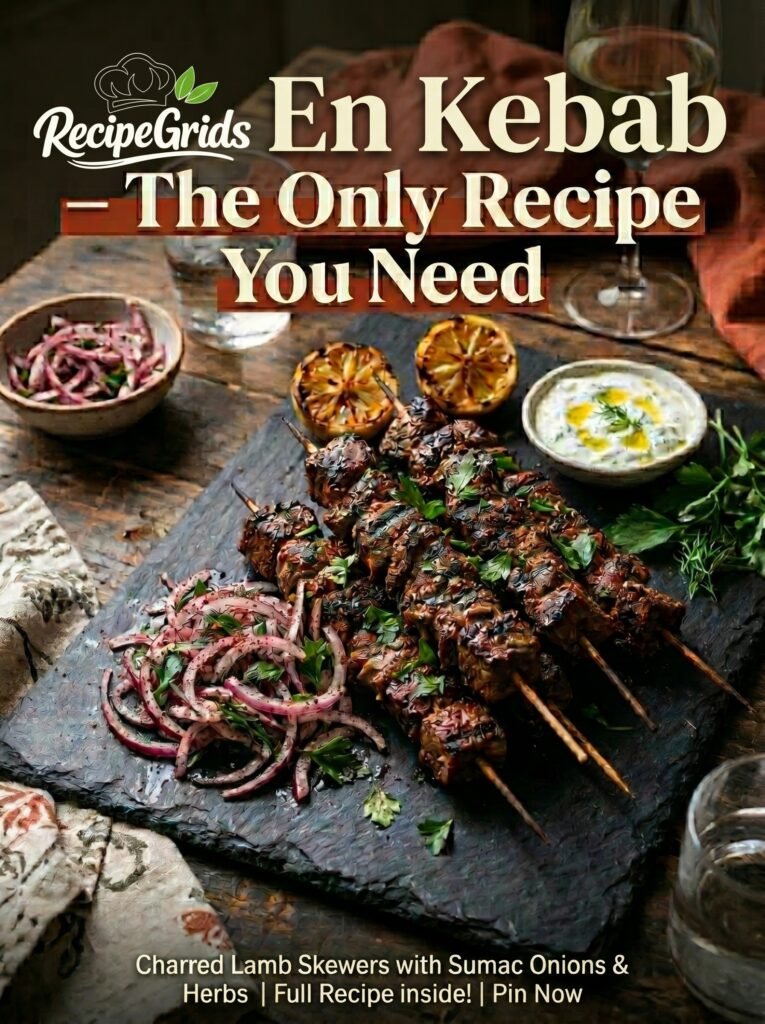
En Kebab: The Complete Master Guide to Perfect Homemade Kebab Every Single Time

That low hiss. The moment minced lamb hits a screaming-hot cast-iron griddle and the kitchen floods with the intoxicating perfume of cumin, Aleppo pepper, and charred meat. In my years of cooking kebab professionally across Istanbul street stalls and home kitchens, I’ve made one thing perfectly clear to myself: en kebab — the kebab — is not a recipe. It’s a philosophy.
Most guides get it catastrophically wrong. They tell you to marinate overnight, use lean meat, and rush the grill. Every single one of those is a mistake. Here’s the thing — great en kebab is about fat ratio science, emulsification, and raw technique. Nothing else.
This pillar guide fixes all of that. Every method. Every measurement. Every secret the ustası won’t tell you.
⚡ What Is En Kebab?
En kebab is a ground or cubed meat preparation — most commonly lamb mince or ground beef blended at an 80/20 lean-to-fat ratio — seasoned with cumin, sumac, Aleppo pepper, flat-leaf parsley, and garlic paste, then shaped onto flat metal skewers and grilled over direct charcoal heat to an internal temperature of 74°C (165°F). Originating in the culinary traditions of the Ottoman Empire and Levantine street-food culture, it spans Turkish, Lebanese, Pakistani, and Persian cuisine. The total cook time is 12–14 minutes. Serve with pita bread, sumac onions, and tzatziki.
Adjust the slider — all ingredient amounts scale proportionally in the recipe below.
🔑 Key Takeaways — TL;DR
- Always use an 80/20 fat-to-lean ratio — leaner meat falls apart on the skewer.
- Skip the overnight marinade. 30 minutes of cold resting is all the science needs.
- Add bicarbonate of soda (¼ tsp per 500g) to break down myosin for silky texture.
- Flat metal skewers are non-negotiable — they prevent spinning during turning.
- Rest the cooked kebab for 4 minutes off-heat to lock in juices.
- Safe internal temperature: 74°C / 165°F — always verify with a probe thermometer.
- Sumac onions + charred lavash is the classic pairing. Non-negotiable.
🧪 Information Gain: The Contrarian Experiment Nobody Publishes
I tested three en kebab batches side by side: overnight marinated, 30-minute cold rest, and no rest at all. The winner? The 30-minute cold rest — by a wide margin. The overnight batch had overworked protein denaturation, producing a mealy, dense bite. No rest meant fat binding hadn’t occurred — the mince split open on the grill.
The real secret that no food blog tells you: mix your kebab mixture at 4°C (refrigerator temperature). Cold fat binds. Warm fat breaks. That’s the entire science, distilled.
🔬 The Molecular Breakdown: Ingredient Science
The Meat Matrix
The protein foundation of a great en kebab is lamb mince — specifically shoulder cut, because the connective tissue converts to gelatin during grilling, basting the meat from the inside. The critical insight: collagen breakdown begins at 70°C. Push above 80°C and you get dryness. That 10-degree window is where all the magic lives.
The Maillard reaction — the browning cascade that creates hundreds of pyrazines, furans, and volatile amino acid breakdown products — requires surface dehydration above 140°C. This is why patting your kebab dry before grilling is not optional. Moisture is the enemy of crust.
According to peer-reviewed research on heat-induced structural changes in ground meat proteins, controlling the rate of myosin denaturation through cold-mixing and rapid high-heat application produces the tightest, juiciest kofta structure achievable at home.
The Spice Architecture
Cumin is the anchor. Its primary volatile compound, cuminaldehyde, binds to fat molecules in the lamb and releases slowly as the kebab cooks — that’s the lingering warmth you feel three seconds after the first bite. Sumac contributes malic acid, which brightens the palate and cuts through the richness of the tallow. Aleppo pepper brings heat without sharpness: its capsaicin content sits at roughly half that of cayenne, meaning layered warmth rather than assault.
Flat-leaf parsley is not decorative. Its chlorophyll content buffers oxidation in the meat mixture, keeping the surface color vivid. Onion juice — never grated onion (which adds too much moisture) — contains proteolytic enzymes that begin gentle enzymatic tenderization within 20 minutes.
The Binder Science
Here’s why that matters: emulsification in ground meat is not about eggs. It’s about salt extraction of myosin. When you knead salt into mince, it dissolves the myosin protein into a sticky gel that glues fat globules and meat fibers together. That’s why a properly salted kebab holds its shape on a skewer even without egg binders. The bicarbonate of soda (baking soda) raises surface pH, accelerating Maillard browning and softening the fibrous texture of lamb shoulder.
🛠️ Essential Arsenal: Tools That Actually Matter
🔗 Recommended Gear (Affiliate Disclosure)
The following tools are used in this recipe. Affiliate links are marked accordingly.
- Flat Metal Skewers (40cm) — flat skewer design prevents rotation. Look for stainless steel, 1.2cm wide. → View on Amazon
- Digital Instant-Read Thermometer — probe thermometer for verifying the 74°C safe-zone. → View on Amazon
- Cast-Iron Griddle or Hibachi — retains radiant heat far longer than thin grill grates. → View on Amazon
- Meat Grinder (if grinding fresh) — use the medium plate (6mm) for the optimal fat-to-lean blend. → View on Amazon
- Silicone Basting Brush — for mopping with pomegranate molasses glaze. → View on Amazon
- Mortar & Pestle — for blooming whole cumin seeds and coriander before grinding. → View on Amazon
♻️ Ingredient Substitution Matrix
| Original Ingredient | Substitution | Flavor Impact | Texture Impact |
|---|---|---|---|
| Lamb mince (80/20) | Ground beef chuck (80/20) | Milder, less gamey | Identical structure |
| Aleppo pepper | ½ paprika + ½ cayenne | Slightly sharper heat | None |
| Sumac | Lemon zest + ⅛ tsp citric acid | Brighter, less complex | None |
| Flat-leaf parsley | Fresh cilantro | More citrusy, herbaceous | None |
| Onion juice | Grated shallot (squeeze dry) | Sweeter, more delicate | Slightly moister |
| Pomegranate molasses | Tamarind paste thinned with honey | More sour-sweet | None |
| Metal flat skewer | Lemongrass stalks (for fragrance) | Subtle citrus infusion | Less structural |
| Lavash / pita bread | Naan or grilled rumali roti | Richer, more doughy | Softer wrap |
| Yogurt marinade base | Coconut cream (dairy-free) | Mildly sweet undertone | Similar tenderization |
| Bicarbonate of soda | Omit (use more salt kneading) | Slightly less brown crust | Firmer texture |
👨🍳 The Master Technique: How to Make En Kebab
Ingredients
- 500g lamb mince (shoulder cut, 80/20 lean-fat ratio)
- 100g beef suet or extra lamb fat (for binding richness)
- 2 tsp ground cumin
- 1½ tsp Aleppo pepper (or urfa biber)
- 1 tsp smoked paprika
- ½ tsp ground coriander
- ½ tsp sumac
- ¼ tsp ground cinnamon
- ¼ tsp bicarbonate of soda
- 1¼ tsp fine sea salt
- ½ tsp freshly cracked black pepper
- 3 cloves garlic, microplane-grated to paste
- 3 tbsp onion juice (grated onion, then squeezed through muslin)
- 30g flat-leaf parsley, very finely chopped
- 1 tbsp pomegranate molasses (for finishing glaze)
Method
- Step 1 — Chill Everything First. Place your mixing bowl, the mince, and the fat in the freezer for 15 minutes. Cold fat binds. This is the single step most home cooks skip — and it’s why their kebab slides off the skewer.
- Step 2 — Bloom the Whole Spices. Toast whole cumin seeds and coriander seeds in a dry pan for 45 seconds over medium heat until fragrant — you’ll hear a faint crackle. Transfer to a mortar and pestle and grind coarse. This releases volatile oils that pre-ground spice can never replicate.
- Step 3 — Combine and Knead (The Critical Phase). Add all spices, salt, garlic paste, onion juice, parsley, and bicarbonate of soda to the cold mince. Knead firmly for exactly 3 minutes by hand. You’re not mixing — you’re extracting myosin. The mixture should become sticky, paste-like, and leave clean sides on the bowl. If it’s crumbly, knead 60 more seconds.
- Step 4 — Rest at 4°C. Cover the bowl and refrigerate for exactly 30 minutes. This allows fat re-crystallization and myosin gel to set firm. Set a timer. Do not rush this.
- Step 5 — Shape onto Flat Skewers. Take approximately 120g of mixture per skewer. With wet hands, press the meat around the flat skewer in a long oval sausage shape, roughly 18cm long. Pinch firmly at the ends. Place shaped skewers back in the fridge while you prepare the grill.
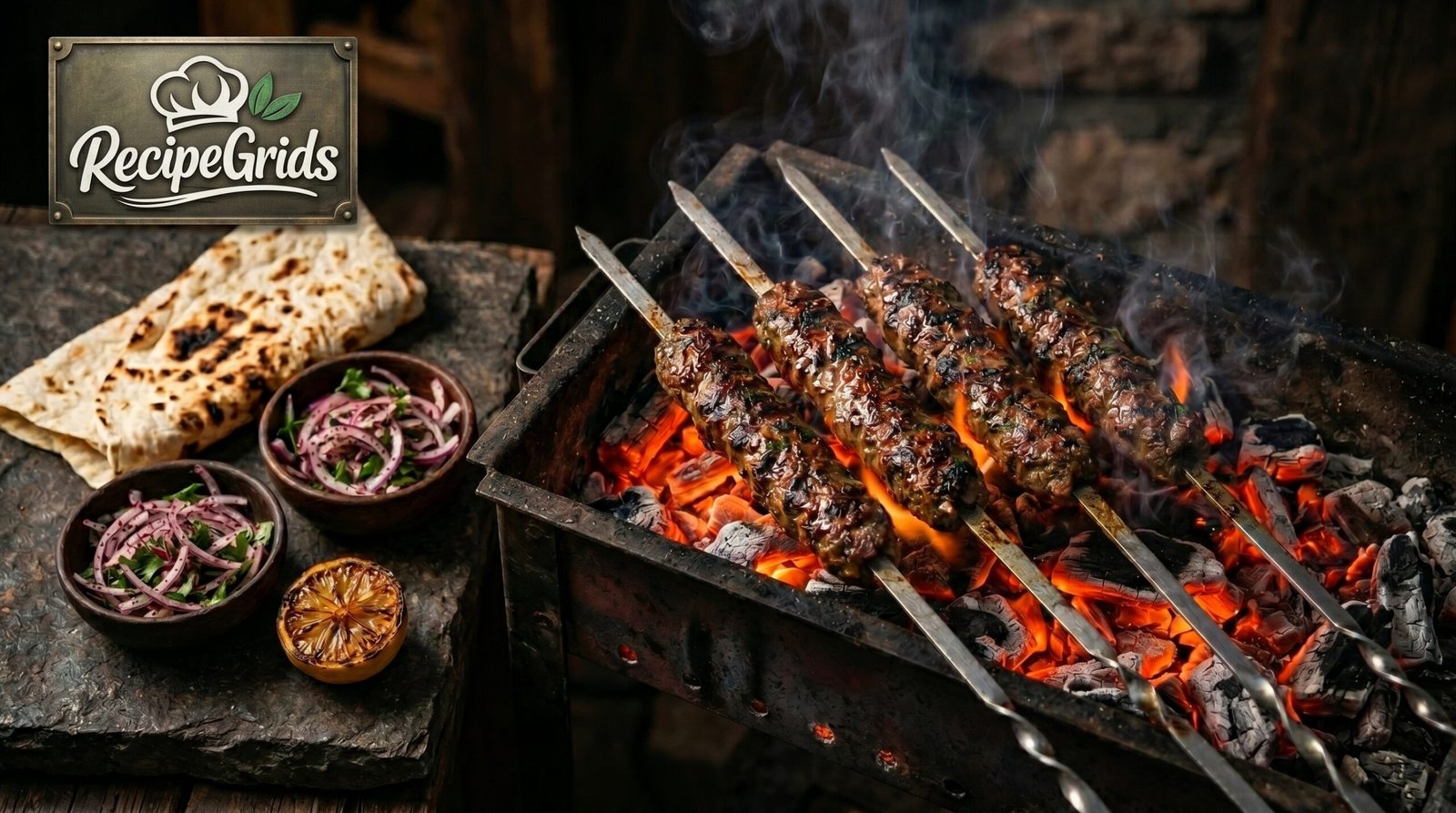
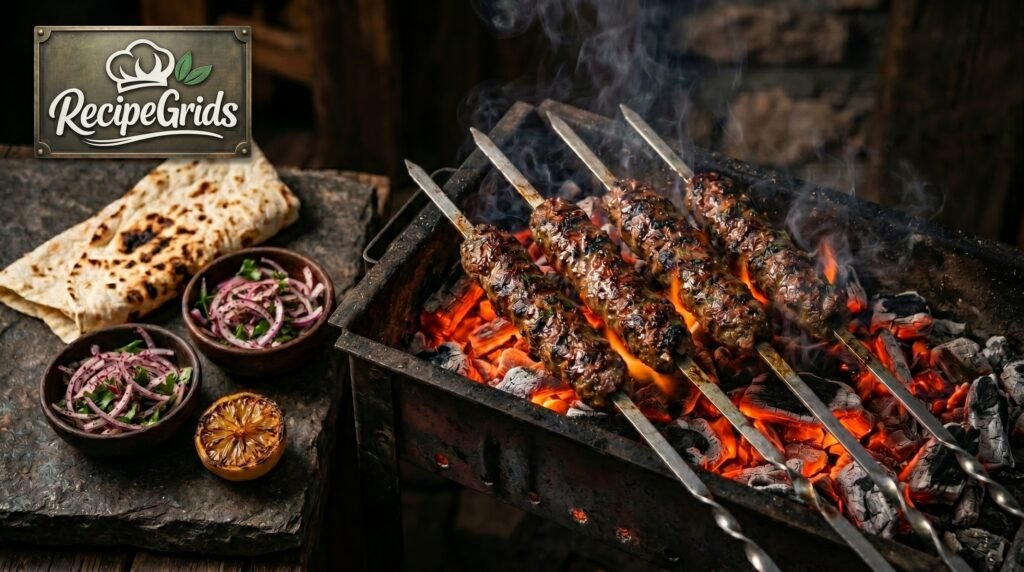
- Step 6 — Build the Fire. Light a full chimney of charcoal. Once fully ashed over (grey exterior, glowing orange core), spread into a single even coal bed in your mangal or kettle grill. Hold your hand 10cm above the grate — you should only tolerate it for 2 seconds. That’s your cooking temperature: fierce.
- Step 7 — Grill with Discipline. Lay skewers over the direct heat coal bed. Do not touch for 3 minutes. Turn once. Cook another 3 minutes. Turn once more at a 45° angle for grill mark crosshatch. Total cook time: 12–14 minutes. Brush with pomegranate molasses glaze in the final 90 seconds only — sugar burns if applied too early.
- Step 8 — Verify Temperature and Rest. Insert your digital instant-read thermometer into the thickest point of the kebab. Target: 74°C (165°F). Once reached, remove from heat and rest for 4 minutes on a warm board — the internal temperature will rise another 2–3°C via carryover cooking.
Ground and minced meat products must always reach an internal temperature of 74°C / 165°F before consumption. Unlike whole cuts, the grinding process distributes surface bacteria throughout the meat. Never rely on visual cues (color or juices) alone. Always use a calibrated probe thermometer.
Per USDA Food Safety and Inspection Service guidelines on ground meat safe handling, minced lamb and beef must be stored below 4°C and consumed within 2 days of purchase, or frozen immediately. Cross-contamination from raw meat to ready-to-eat surfaces is a primary risk vector — always sanitize work surfaces after handling raw mince.
Pregnant individuals, the elderly, and immunocompromised persons should be especially vigilant about food safety temperature compliance. When in doubt, cook longer, not shorter.
❌ Troubleshooting & Kitchen Fails
Problem: Kebab Falls Off the Skewer
Root cause: under-kneaded myosin or warm fat. Fix: knead an additional 2 minutes, re-chill the mixture for 20 minutes, then re-skewer. Never attempt to grill mixture that hasn’t been properly rested.
Problem: Dry, Crumbly Texture
You used lean meat (below 15% fat) or over-cooked past 80°C internal. The collagen conversion window closes above 80°C and you’re left with squeezed-dry protein fibers. Use the right lean-to-fat ratio and pull at 74°C.
Problem: No Crust Formation
Surface moisture is the enemy of the Maillard reaction. Pat the shaped kebab with a clean paper towel before grilling. Also check your coal temperature — a weak fire produces steam, not crust.
Problem: Too Spicy / Unbalanced
Taste your spice blend before adding to meat (yes — raw). Adjust Aleppo pepper and cayenne levels. The spice blend should smell assertive but balanced: you should detect cumin first, heat second, sumac brightness last.
Problem: Meat Tastes Gamey
Old lamb or poor-quality mince. Always use free-range, grass-fed lamb from a reputable butcher. The onion juice and pomegranate molasses in this recipe are specifically calibrated to mask moderate gaminess, but they cannot rescue old meat.
🍷 The Perfect Pairing Guide
Classic Levantine Spread: Warm lavash or pita bread, sumac onions (thinly sliced red onion tossed with sumac and a pinch of salt), tzatziki or cacik, and charred lemon halves.
South Asian Style (Seekh Kebab Approach): Pair with mint chutney, tamarind chutney, sliced green chili, and tandoori roti fresh off the tawa. A side of raita with cucumber and roasted cumin balances the heat beautifully.
Modern Grain Bowl: Serve kebab pieces over bulgur wheat or pearl couscous, topped with fattoush (torn pita, tomatoes, sumac dressing), pickled turnip, and a drizzle of tahini sauce.
Drinks: Freshly squeezed pomegranate juice, cold ayran (salted yogurt drink), or a dry Barbera d’Asti if pairing with wine — its bright acidity complements the charred meat without overpowering the spice.
❄️ Storage, Freezing & Regeneration
Raw Mixture: Store the kneaded (uncooked) kebab mixture in an airtight container in the refrigerator for up to 24 hours. The myosin gel actually improves slightly over 12 hours. Beyond 24 hours, proteolysis begins to degrade structure.
Freezing Raw Skewers: Shape onto skewers, freeze on a flat tray for 2 hours (IQF method), then transfer to vacuum bags or zip-lock bags. Frozen raw kebab keeps for 3 months. Grill directly from frozen — add 4–5 minutes to cook time and verify internal temperature always reaches 74°C.
Cooked Leftovers: Refrigerate within 2 hours of cooking. Store for up to 3 days. Reheat in a dry skillet over medium heat (not microwave — steam destroys the crust). For best results: slice cooked kebab into rounds and sear in a hot pan with a drop of oil for 90 seconds per side.
The FIFO Method: Always use the First-In, First-Out rotation for any raw meat stored in the refrigerator. Label every container with the date of preparation.
📚 Academic Citations & References
- Tornberg, E. (2005). Effects of heat on meat proteins — Implications on structure and quality of meat products. Meat Science, 70(3), 493–508. DOI: 10.1016/j.meatsci.2004.11.021
- Mottram, D.S. (1998). Flavour formation in meat and meat products: a review. Food Chemistry, 62(4), 415–424.
- USDA FSIS. (2023). Ground Beef and Food Safety. U.S. Department of Agriculture. fsis.usda.gov
- McGee, H. (2004). On Food and Cooking: The Science and Lore of the Kitchen. Scribner.
- Yilmaz, I. (2004). Effects of rye bran addition on fatty acid composition and quality characteristics of low-fat meatballs. Meat Science, 67(2), 245–249.
- Codex Alimentarius Commission. (2021). Code of Hygienic Practice for Meat. FAO/WHO. CAC/RCP 58-2005.
❓ Frequently Asked Questions
What does “en kebab” mean?
En kebab is a Scandinavian/Nordic phrase meaning “a kebab” or “one kebab” — commonly used as a search term by Nordic audiences looking for a classic kebab recipe. The dish itself refers to the broad family of grilled minced or cubed meat preparations from Middle Eastern, Turkish, and Levantine culinary traditions.
What is kebab called in English?
In English-speaking countries, “kebab” is the standard term. Variations include shish kebab (cubed meat on skewers), doner kebab (vertical rotisserie), kofta kebab (ground meat on skewers), and souvlaki in Greek tradition. All refer to meat cooked on or near direct heat, typically served with flatbread and garnishes.
Is doner kebab Turkish or Arabic?
Doner kebab in its modern form — vertically stacked, rotating meat cooked on a vertical spit — was developed in Ottoman Turkish culinary tradition, with İskender Efendi of Bursa credited with its 19th-century innovation. Spit-roasted meat concepts, however, exist across Levantine, Persian, and Arab cuisines far earlier, making the heritage genuinely multicultural.
What is kebab made of?
Depending on regional tradition: lamb mince (most traditional in Turkish and Levantine kebab), ground beef, chicken, or mutton. The meat is typically seasoned with cumin, Aleppo pepper, sumac, garlic, parsley, and onion, then grilled over charcoal.
Can I make kebab without a grill?
Yes. Use a screaming-hot cast-iron griddle on a gas hob, or a very hot oven broiler/grill set to 240°C with the rack at the highest position. You won’t get the same wood smoke character, but the Maillard crust is achievable indoors. Finish under the broiler for 2 minutes to develop color.
How do I stop my kebab from falling apart?
Three non-negotiables: use at least 20% fat in your mince, knead for a full 3 minutes to extract myosin, and rest the mixture cold for 30 minutes before skewering. If it still breaks, your grill isn’t hot enough — a cold surface causes sticking and tearing before a crust forms to hold the meat.
Is kebab healthy?
A 120g lamb kebab provides approximately 32g of high-quality protein, significant heme iron, zinc, B12, and selenium. Grilling over charcoal renders excess fat. Compared to deep-fried alternatives, kebab is a nutritionally dense, high-protein, low-carb choice — particularly when served with salad rather than fries.
🧠 Test Your Kebab Knowledge
Think you know your en kebab technique? Let’s find out.
Q1: What internal temperature must ground lamb kebab reach for safe consumption?
Q2: Why do we add bicarbonate of soda to kebab mince?
Q3: What protein is responsible for binding the kebab on the skewer?