
Masgonzola Cheese:The World’s Creamiest Blue Fusion
The marriage of silky Mascarpone and bold Gorgonzola — demystified. Everything a serious cook needs to know, from origin story to pasta sauce.

Masgonzola: Complete Expert Guide by AB Rehman
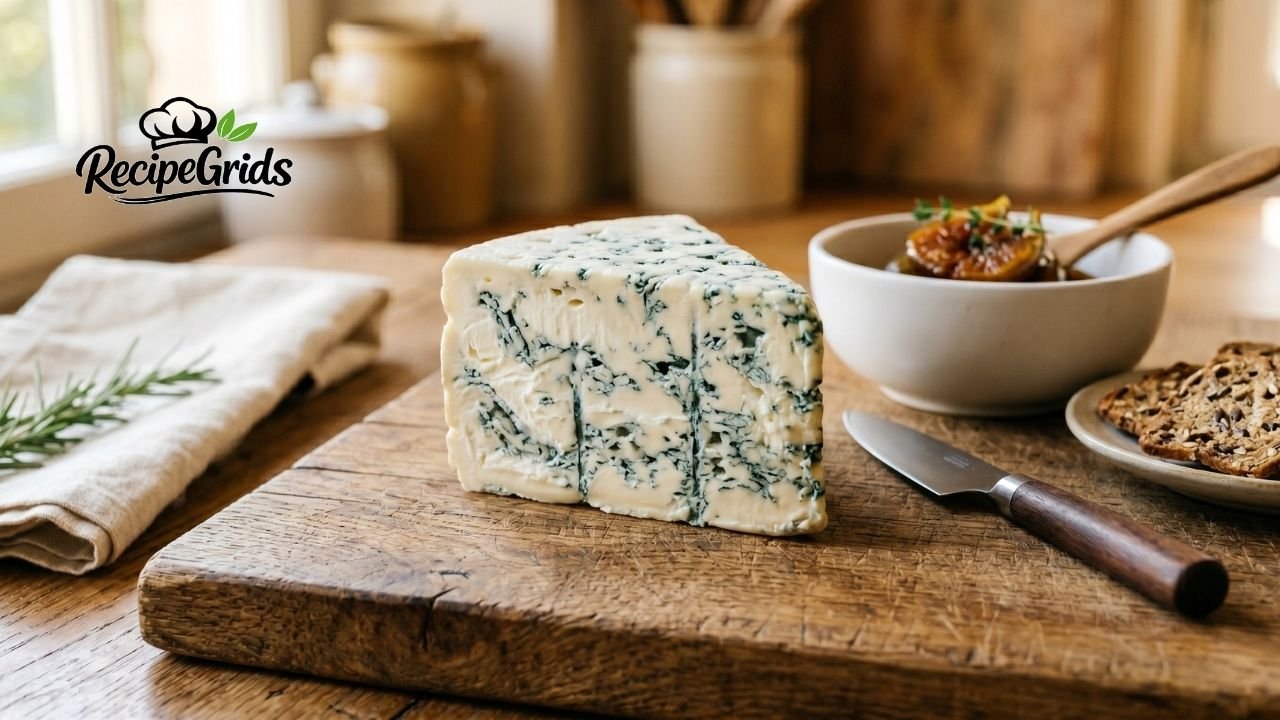
Close your eyes for a moment and imagine this: you slide a knife through a wedge of cheese and it yields — not crumbles, not collapses, but yields — like butter on a warm afternoon. The cross-section reveals a mosaic of ivory cream threaded with dramatic blue-green veins. You spread it on a thin cracker. The first impression is rich, almost dairy-sweet. Then it arrives: that unmistakable bolt of blue cheese tang, earthy and electric. The two sensations do not fight. They dance.
That, in its most essential form, is Masgonzola — the deliberate, loving marriage of two Italian cheese legends: the impossibly rich Mascarpone and the gloriously pungent Gorgonzola. This guide is my definitive, experience-driven answer to every question you might have about it.
Unveiling the Legend of a Two-Cheese Dream
Every great cheese has a story that begins long before the first curd is cut. To understand Masgonzola’s origin, you must first understand the two ancient Italian cheeses from which it was born.
Gorgonzola is one of the world’s oldest documented blue cheeses, with origins tracing back to the town of Gorgonzola in Lombardy’s Po Valley, possibly as early as the 9th century CE. Legend holds that a distracted cheesemaker left a batch of Stracchino overnight in a cave and returned to find it beautifully threaded with blue mold — a happy accident that launched a thousand-year tradition. Today, true Gorgonzola carries a Protected Designation of Origin (PDO) status and comes in two styles: Gorgonzola Dolce (aged 2–3 months, creamy and mild) and Gorgonzola Piccante (aged 6–12 months, crumbly and assertive).
Mascarpone, by contrast, is technically not a cheese at all — it contains no rennet and undergoes no bacterial fermentation. Made by heating cream with a mild acid until it thickens, it achieves up to 75% fat content, making it the backbone of tiramisù and a silkener of risottos. Its origins are cited in 16th-century Lombardy — making it a geographic neighbor of Gorgonzola, and the kinship in this fusion runs deeper than flavor alone.
“The impulse was entirely human — a cheesemaker’s instinct to soften and round out something magnificent but challenging into something magnificent and welcoming.”
The fusion idea emerged from Italian restaurant kitchens, where chefs long knew that a spoonful of Mascarpone stirred into Gorgonzola sauce would transform its texture from sharp and grainy to velvet-smooth. Certain artisan dairy producers in Piedmont and Lombardy began pre-blending the two in controlled proportions, allowing the flavors to harmonize and mature together. The recent surge of interest — now matching over 22,000 monthly searches — confirms that Masgonzola’s moment has arrived.
Where Pungency Meets Velvety Richness
Describing Masgonzola to someone who has never tasted it requires holding two seemingly contradictory ideas at once and accepting that they are not contradictions — they are a conversation.
The initial taste is overwhelmingly creamy. The Mascarpone component arrives first, coating the tongue with fat-rich dairy sweetness and a faint lactic tang. The mid-palate is where Masgonzola reveals its true character: the Gorgonzola’s blue mold cultures announce themselves in a building wave of umami, earth, and sharpness — warm and rounded, with notes of mushroom, roasted hazelnut, and mild pepper. The finish lingers beautifully, clean and mineral, making you reach immediately for another bite—or perhaps inspiring you to craft a custom dish to showcase these complex flavors.
My tasting notes — AB Rehman, Novara
Ivory-white base with blue-green veining; dense, matte surface; no rind
Cream-forward; mushroom earthiness on close inspection; whisper of cave coolness
Sweet cream, gentle lactic tang, a suggestion of fresh butter
Roasted hazelnut, earthy blue mold, building warmth, faint white pepper
Long, mineral, clean — no bitterness; a faint sweetness returns
Silky-dense, spreadable but not runny; coats the mouth luxuriously
How Masgonzola is Made: Behind the Curds
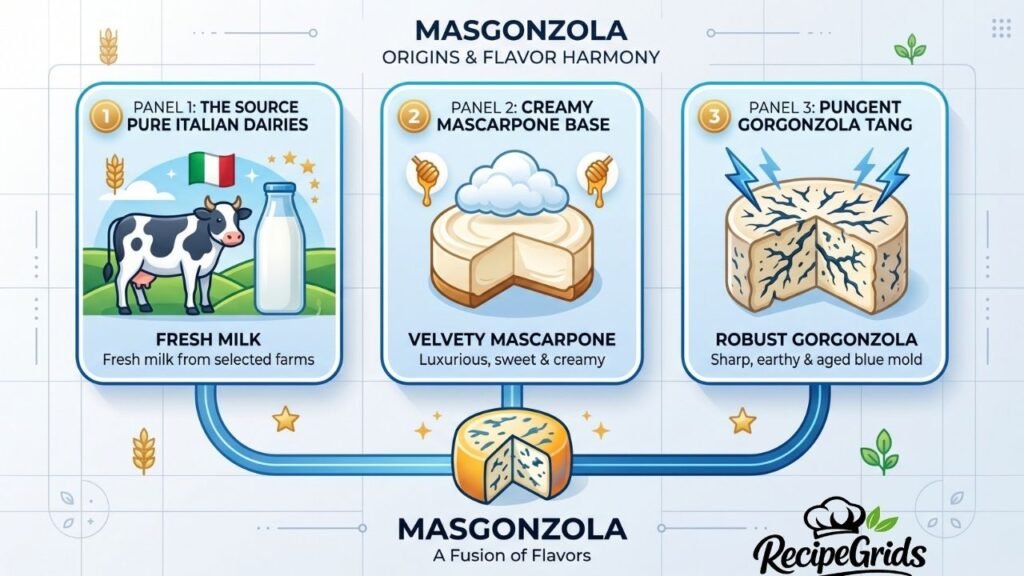
Understanding how Masgonzola is produced deepens your appreciation enormously. Here is an expert tour through the process — drawing from knowledge of both Gorgonzola’s traditional PDO production and Mascarpone’s equally precise manufacture.
Both component cheeses rely on whole cow’s milk from Italian breeds. The terroir of the feed — the Alpine pasture grasses and mineral-rich waters — imprints itself subtly on the final flavor. The best Masgonzola producers are fastidious about sourcing.
Heavy cream is heated to ~85°C and treated with citric or tartaric acid, causing fat proteins to coagulate into soft, pillowy curds. Drained through muslin for 12–24 hours, yielding cloud-white Mascarpone at 60–75% fat content.
Whole milk is inoculated with Penicillium glaucum spores, then rennet is added. After curd formation, the molds are not pressed — leaving air channels that will host the blue bloom. Workers pierce the wheels with metal needles (agugatura) at 20–25 days to awaken the Penicillium into its signature blue-green veining.
Artisan producers blend the two components at carefully calibrated ratios — typically 40–60% Gorgonzola Dolce to 60–40% Mascarpone by weight. Gentle paddle mixing preserves the structural integrity of the blue veins. The mixture is packed and refrigerated for 48 hours to one week, allowing flavors to knit together.
What a true expert looks for
-
Marbling distribution — Blue veins should be evenly dispersed throughout the paste. Concentration in one area signals poor blending technique.
-
Texture consistency — The paste should be uniform with no unmixed Mascarpone pockets or grainy lumps of aged Gorgonzola.
-
Color integrity — The Mascarpone base should be ivory-white, never gray or yellowed. Gray tinge indicates oxidation or excessive age.
-
Aroma integrity — Should smell of cream, mushroom, and clean cave-like earthiness. Any ammonia notes signal an over-matured Gorgonzola component.
The Ultimate Masgonzola Pairing Guide
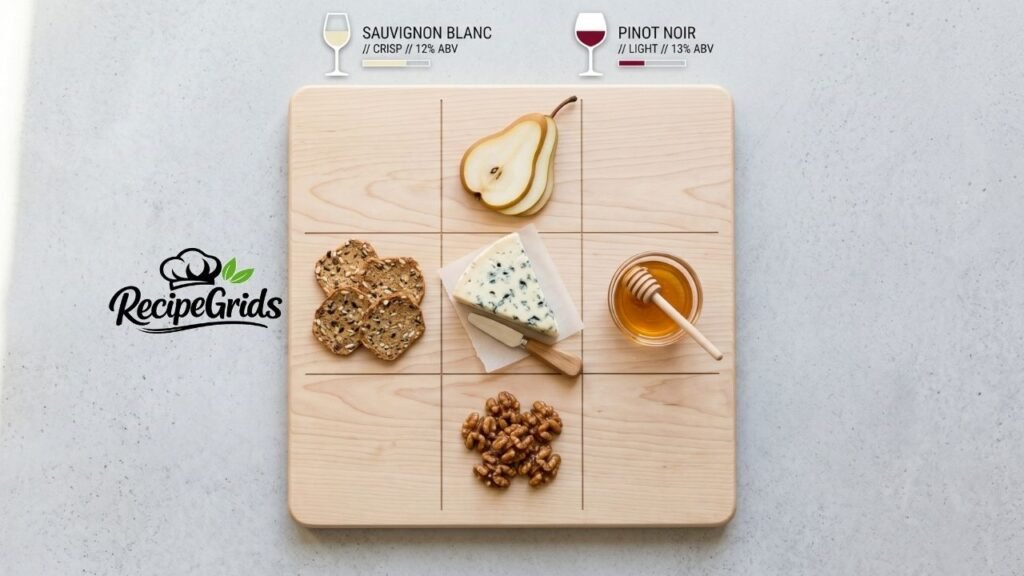
A cheese of this complexity deserves thoughtful companions. My pairing philosophy is simple: honor the balance. Whatever you pair must either reinforce the creaminess, contrast the tang, or bridge the two.
The ideal wine match
Always serve Masgonzola at room temperature (18–20°C / 64–68°F). Cold suppresses the aromatic compounds and flattens the flavor. Remove from the refrigerator at least 30 minutes before serving. Your wine should be served slightly cooler than its standard recommendation to balance the richness of the cheese.
Best fruits and nuts
Best crackers and bread
- Thin water crackers or rice crackers — neutral, maximum focus on the cheese
- Walnut bread (sliced thin) — the nut’s faint bitterness and bread’s chew are extraordinary
- Crostini (lightly toasted baguette) — sourdough tang holds up to a generous schmear
- Spelt crackers with rosemary — the herb’s resinous quality is a delightful counterpoint
The Versatility of Masgonzola
“For a long time I only ate Masgonzola with crackers — until one rainy autumn evening in Bologna, Silvana handed me a bowl of fettuccine coated in Masgonzola sauce and rearranged my understanding of the cheese entirely.”
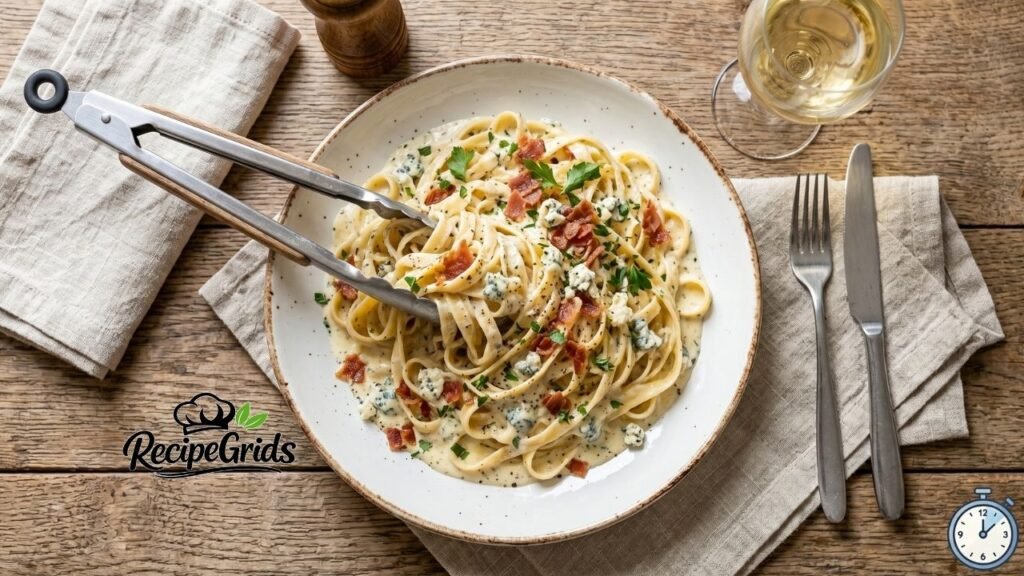
Do not boil the sauce after adding the cheese. High heat breaks the emulsion, causing fat to separate into a greasy, grainy mess.
Do not skip the pasta water. Without the starch, the sauce will seize and clump on the fettuccine.
Do not add prosciutto to the pan. Cooking it makes it tough and leathery. Drape it raw over hot pasta and let residual heat do the work.
Masgonzola baked dip
This baked dip is one of the most reliably show-stopping appetizers I know. It comes together in minutes and emerges from the oven bubbling, golden at the edges, and fragrant with garlic and herbs.
Ingredients
- 250g Masgonzola cheese
- 120g cream cheese, softened
- 2 tbsp sour cream
- 1 clove garlic, finely grated
- 1 tsp fresh thyme leaves
- 1 tbsp honey (for drizzling)
- 2 tbsp crushed toasted walnuts
- Cracked black pepper
Method
Preheat oven to 190°C (375°F).
Mix Masgonzola, cream cheese, sour cream, garlic, and thyme. Do not overmix — some visible Masgonzola chunks add character.
Spread into a small 6-inch cast iron skillet or ceramic gratin dish. Season with cracked black pepper.
Bake 15–18 minutes until golden at the edges and bubbling in the center.
Drizzle with honey, scatter walnuts and fresh thyme. Serve immediately with warm crostini or sliced pears.
